Cycles of emergence map audaciously improbable impossibilities.
Season of Spiderwebs
Cycles of Emergence
“How do small, repeated actions lead to emergent change in a large, complex system?” Pieter de Beer and Nick Takamine explore this question in their October 16 article “The Dynamics of Emergence.”
Building on the idea of emergent strategy as introduced to many of us by adrienne maree brown, this article proposes that, “Emergent systemic change is not caused, but conducted,” as through a power charge released when resonance has been built among diverse but aligned actors and reaches a “tipping point.” Using language from science (“field phenomenon”) and music (“amplification”), they describe a becoming that arises out of such convergence. Calling this process “Power Through,” they suggest that it carries the potential for “bringing possibilities that were previously improbable, even unthinkable, into the zone of immediate viability.”
Sound like magic? That’s what I thought too. To quote from a very different notebook I keep: “At its core, witchcraft is relationships. Laugh at my alliances with river deities, spirits riding the sea’s salted winds. Laugh at my conversations with the tree spirits if you wish. I know exactly where my power to nudge the world comes from.” Emily C. Banting 1982 (hookland@bsky.social) The dynamic of emergence is that of nudging the future into being.
Another of de Beer and Takamine’s descriptions of what conducting (conjuring?) emergent change looks like observes: “Coherence can’t be imposed. We can only create the conditions for it to emerge from relational attunement, feedback loops, and shared frameworks of meaning among network participants.” And they’re not just blowing smoke. The authors cite examples in the protest movement in Hong Kong in 2019-20, the Black Lives Matter uprisings of 2020, and the ongoing work of The Participatory Budgeting Project. These expressions of emergence lift up two conditions for success: resistant infrastructure (based on relationships of voluntary coordination) and narrative sovereignty (resistance to cooptation or “institutional absorption”).
Some few days later, I read an article in NPQ (“What is Collective Narrative Infrastructure and Why Does it Matter?” by Emi Aguilar and Trevor Smith) that dovetails with these ideas, addressing the topic of narrative infrastructure and its critical role in building collective power within and across movements. This piques my interest as a writer and a witch: if Power Through is “responsive to what is practiced and repeated” (as incantations, spells, or other “words of power”), the narratives and stories we tell must be WORTH repeating.
“The Dynamics of Emergence” uses the imagery of a conductor finding alignments across different players and drawing them together—this also speaks to weaving, as a spiderweb. “Sometimes it is about tending threads we may never see woven into final form. This is not a passive stance. It is an active, devoted cultivation of conditions where the unexpected becomes possible.”
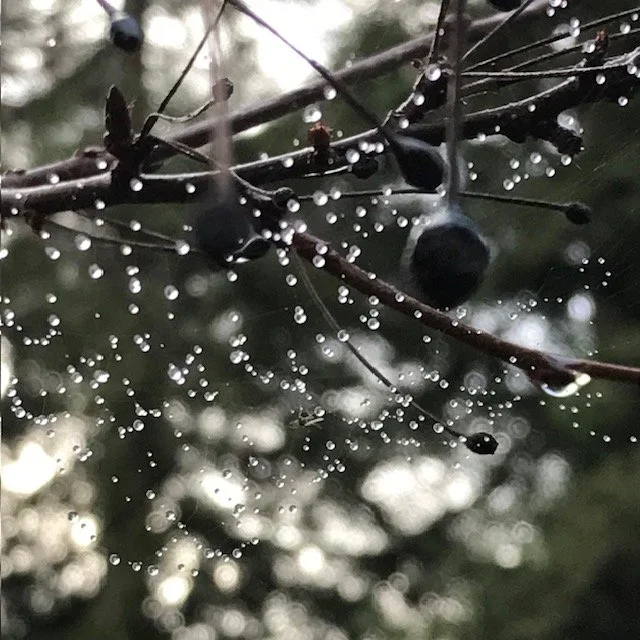
Spiderwebs are emergent. I’d love to throw away the mechanistic metaphor we’ve become accustomed to using about “building the plane while flying it” and instead turn to the spider, who is supported by their own weaving as they are creating it. Becoming the spider, somewhat like a tiny rock-climber, you’re pinning in supports you use as you tie in more linkages in a self-suspending system of threads connected in patterns strategically designed to meet a need (in the spider’s case, to capture prey) that is also beautiful in its imperfect symmetry.
Walking this web while pinning it together speaks to what the authors cite here:
“Governing for emergence is not about mechanical execution of a master plan, but about purposeful navigation of the adjacent possible, a concept coined by theoretical biologist and complex systems researcher Stuart Kauffman to describe the successive frontiers of immediate possibilities we encounter as we move through time. Navigating the adjacent possible is about taking the next step, and the next, and the next, iteratively sensing, reorienting, acting, and learning, to both respond to and shape our unfolding reality.”
Burn Scar
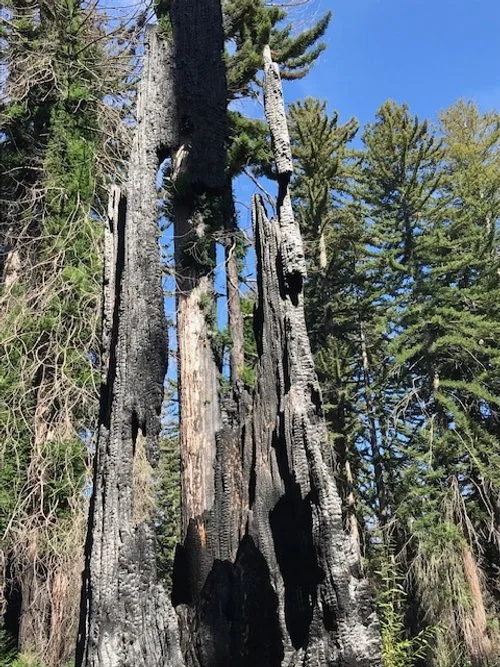
Big Basin State park, Ca - two years following the Czu lightning complex fire
Sometimes, while driving on a day trip or just taking the long way home, my sensibilities are shocked when moving from a familiar forested landscape to one that has been dramatically transformed by fire. I live in the Santa Cruz Mountains, which has seen its share of fires: some five years ago, some fifteen, and more reaching through history. In recently affected areas, there is a heartening amount of bright green regrowth and regeneration. There are, too, the skeletons of charred trees, bare and vulnerable, some pointed like elk horns, others standing charcoal sticks, the absence of foliage now crowded by open sky.
It appears an alien terrain, not quite right. Unsettling, sometimes even spooky. It is at once a reminder of our vulnerability and a testament to resilience—the temporary and the timeless. Never will the effects of the fire be invisible or forgotten. Our fire-touched ecosystems remind us that when devastation and loss occurs, life does persist, healing can happen, and still we are forever changed.
Burning Love: An Invitation to Transformative Action faces the ruin, touches the soot and ash left behind by the fires of hate, searing selfishness, and smoldering disregard. Palpable, undeniable… unacceptable. The brown paper is rich in content and heart, while its visual design tells the rest of the story: sooty, like charcoal on stone, timeless and elemental.
This paper is the first in which I’ve seen the decolonizing practice of what Sabrina Meherally and sahibzada mayed صاحبزادہ مائ)) of Pause & Effect have lifted up as the participation of the more than human world as researcher, not just researched. In it, artist Cielo Morales shares that they created illustrations using a suminigashi ink-floating technique in co-authorship with waters collected from meaningful sites, and that the waters’ respective histories are visible in the resulting images. It is an example of making space for stories that don’t just center our human experience, but that of the lands and waters that weather the same shocks and transformations that we do.
Burning Love is part of a trilogy that draws on elemental understandings. The first paper in the series, Measuring Love, asked us to be amphibious in our ability to move fluidly between the surface and depth of things. Healing Love: Into Balance invited us deeper into the soil work of composting what no longer serves us. This third paper in the series burns with fire.
While it speaks to the urgency and damage of the metaphorical house on fire in which we find ourselves, it also sparks hope and challenges us to claim our own power to act—knowing what needs to be saved, and what to let burn away. The paper offers so much, including this parting message that worldbuilding for a more loving and just future has already begun:
“Hope is not passive. It is a daily, embodied practice. The liberation we seek does not exist solely in grand declarations or future aspirations—it is being built in the margins, in the cracks of empire, in the spaces where love and resistance live side by side.”
This imagery again calls to mind the humble spider, working away unnoticed in the corners and in-between spaces, spinning its silk and building the beautiful.