PLANT BASED: Stepping Into Presence in the Garden
Book to be published October-November 2026
Preview Excerpt (posted 9/26)
“Seeds”
Many of us get excited about seed planting at the first signs of spring, letting theme embody our hope for the new. But we are often slower to circle back and honor seeds at summer’s end when they come not from a brightly colored packet in a catalog but in pale husks—or fall altogether unnoticed to the ground.
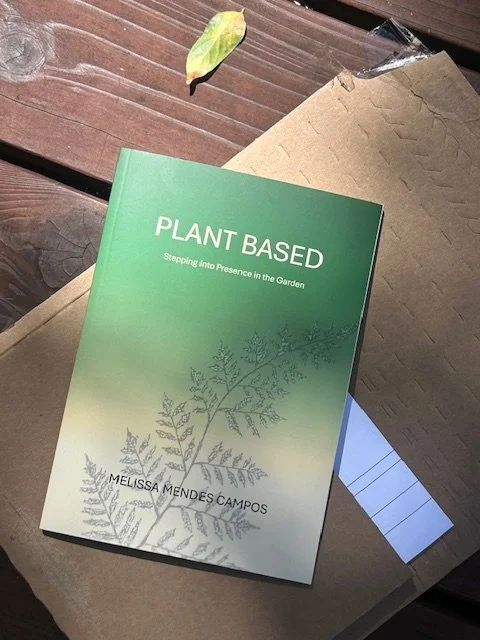
advance copy of plant based, book with green and pale yellow cover with etching of a fern frond
Seeds aren’t merely to be planted, but to be collected.
Maybe it’s no accident that spring’s fascination with seeds is often commercial, packaging playing a big role in capturing our imaginations and promising produce (literal production), whereas end-of-season seed collecting and seed saving is profoundly anti-commercial.
By late summer, our garden’s own seed-making typically escapes our attention. Rather, it’s the “weed” seeds we notice, the dandelion and milkweed fluff carried on the breeze to trigger seasonal allergies, or burrs and other hitchhikers catching a ride on our socks from a weekend hike. We may not notice the seeds of fallen tomatoes left to decompose until the volunteer plants remind us the following year.
But seeds happen in the summer! As flowers fade and fall, as weeds proliferate and reproduce, as overripe fruit drop to the ground and begin to decay, they reduce down to their essence, the hardened, hardy seed.
Some stay in place (nativized plants like weeds and grasses), dormant until naturally awakened by spring. Others, humans have collected for generations, saved and stored for cultivation. Or seeds consumed, as the sunflower—seeds as food since before agriculture. Concentrated nutrition. It’s wondrous that pumpkin seeds have something like fifteen times more protein than pumpkin itself (not to mention a ton of minerals). Amazing, right?
And consider the many different shapes of seeds. The ways they are designed to move and travel. Puffballs, corkscrews, jumping, drilling, seeking again the soil to rest, then germinate to new life.
So the end of summer yields not just harvests of produce but of seeds. Fruition, death, and potential for future growth. An apt time for us to reflect.
What has been fulfilled from our summer gardens? What fruit have we partaken of? What flowers enjoyed? And what too has “gone to seed,” whether through neglect or just being allowed to progress in its own time by nature (not needing to be valued solely by what of it can be consumed)? The ending of those blossoms, changed from supple petals and bright colors to tiny shelled granules, dark and contained compared to the openness of a flower. Wizened. Distilled. Concentrated potential. The large thing mapped out in the DNA of the small.
How many of us bother to collect seeds? What seeds am I collecting—not just literally but figuratively—from this season to carry to the next? What things have withered on the vine from neglect or lack of resources? What seeds am I drawing from the sweet flesh of fruit I have enjoyed? What seeds might I nibble at raw now and what seeds will I protect and plant in the coming year? What might I simply let go to seed and work itself out, independent of my meddling or machinations?
As gardeners (if not always in life), we choose what we wish to repeat, and key to remaking it again lies within, in the form of a small, dry seed.
It can be easy to miss our chance. This year, I was slow to gather seeds from the California poppies in my yard because I didn’t want to disturb the flowers they still held, or the bees and other pollinators frequenting them. So, as they are designed to do by nature, the seed pods dried and burst open on their own, scattering next year’s blossoms onto the same soil that had sustained them so well this year. Inconvenient for me, who had hoped to relocate the rangy but colorful poppies to another part of the years—but I admire the seeds’ own agency that keeps life life-ing right here in the garden.
The Vision (posted 9/25)
Reflections on the natural world gently reminding us of what we already know about how to begin, grow, thrive and end.
Each time I walk out into the yard and garden is a chance to see it differently, to notice something new, to stumble onto a fresh idea, or to reconnect to what I already deeply know. I think reminding, or re-minding, is a big part of what I’m trying to share with this book. I experience it as a coming back to my self and my senses. It’s calming the noise in my mind chatter enough to recover what it is I really think and question and wonder.
Because among all the mismatched but still harmonious chaos of weeds, vegetables, vines, ferns, trees, herbs and things, each one—even each part of one—holds lessons or just opportunities for reflection in a way that’s fractal: pointing to similar and larger truths. But also their own ineffable truths because sometimes a flower is just a flower, a miracle in itself.
And it is big. It’s about more than healing. It’s not just self-development. It’s being in community with plant life and the other more than human life around us that never finds us truly alone, that deserves our attention, and that sustains us. It’s our shared birthright and responsibility. It’s our home.
I feel that the more I take responsibility for and get into relationship with my little front yard vegetable garden, the landscape plants growing up around my house, the hanging plants on the back patio, and the variety of trees on the land on which I reside—land that has never been mine but which I steward—the better I can do my part for myself, the people I love, and the earth.
I want to share this with others because we are ALL plant based. From our food web to the air we breathe and the water we drink—none of it would happen without plants. WE couldn’t happen without plants.
I would like readers to experience this book feeling calm, fortified, and better resourced. And to feel inspired to take action to tend or plant a garden, to be kind to animals, to think about stewardship of the earth as stewardship of (caring for) ourselves.
Because there is no self-care without caring for the earth. Saving the planet is the ultimate self-care. Plants are just a medium (albeit a very apt one) for a bigger picture call to be a good human on this planet.